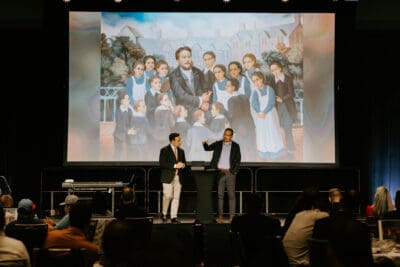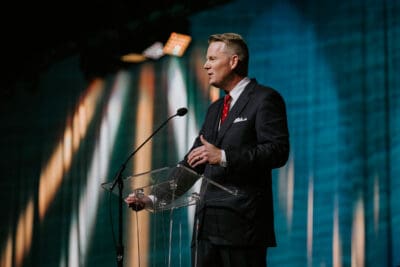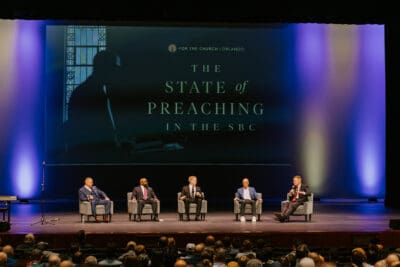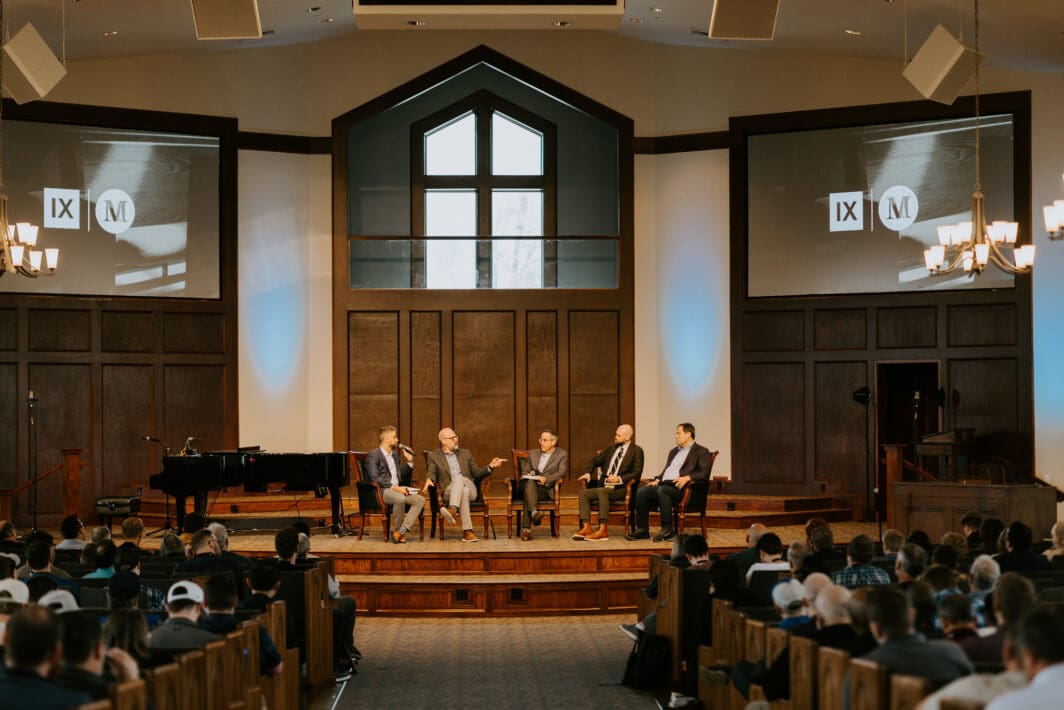
KANSAS CITY, Mo. – Midwestern Seminary recently hosted the 9Marks at Midwestern Conference—a two-day conference on April 21–22 centered on the relevance of Scriptural truths for the pressures facing the church today. Speakers Jason K. Allen, Mark Dever, Jonathan Leeman, Jason G. Duesing, Sam Bierig, Zach Schlegel, and Philip Van Steenburgh led nine plenary sessions, each followed by a panel discussion on the respective topic.
The nine sessions addressed key marks of church life and ministry: expositional preaching, leadership, discipleship, gospel doctrine, conversion and evangelism, prayer, church membership, church discipline, and missions.
Expositional Preaching
Midwestern Seminary President Jason K. Allen opened the conference by emphasizing expository preaching as the foundational mark of a healthy church. He stated that expository preaching “is to actually interpret the text in its context, to explain the text, and to bring it to bear on the lives of the hearers.”
Allen highlighted 12 key commitments and benefits of expositional preaching, all serving one major point: expository preaching is essential to the health of the church, shaping both the preacher and the congregation.
He especially emphasized that the preacher is not simply dispensing opinions, but what the Lord Himself says: “Our people need a clear, authoritative word. They need to get it from the pulpit, and in this age—especially as we enter the pulpit with the Bible—we need to hear Paul’s instruction to speak these things with all authority.”
Leadership
Jonathan Leeman, president of 9Marks, led the second session, focusing on the biblical offices of elders and deacons. He explained that elders serve as pastors, overseers, and shepherds who provide teaching, leadership, and spiritual care for the church.
Leeman noted the New Testament pattern of a plurality of elders who lead through sound doctrine and personal example. “What’s crucial to recognize is that the work of elders only functions when there is trust between members and elders,” he said. “A healthy church has leaders who are trustworthy, but it also has members who are willing to trust.”
He also outlined the role of deacons, who serve the church by meeting tangible needs, protecting and promoting church unity, and serving and supporting the ministry of the elders. Together, these offices reflect Christ’s care for His church and contribute to its overall health and mission.
Discipleship
In the third session, Jason G. Duesing, provost of Midwestern Seminary, taught from 1 John, emphasizing that Christian discipleship is grounded in the revelation of Christ and the fellowship that flows from Him.
He highlighted Christ as the “Word of Life,” noting that the incarnation makes God truly known. “The life was made manifest,” Duesing said, underscoring God’s self-revelation in Christ.
He further noted that proclamation flows naturally from this reality: “that which we have seen and heard we proclaim also to you.” Discipleship, he stressed, is centered on the person of Christ and results in fellowship with God and His people.
Gospel Doctrine
Zach Schlegel, senior pastor of First Baptist Church of Upper Marlboro, addressed gospel doctrine next, making the point that believers stand and grow in the Christian life only through the gospel of Jesus Christ. He summarized the gospel as the good news that Christ died for our sins, was buried, and rose on the third day for our justification so that anyone who trusts in Christ will have their sins forgiven, reconciling them to Christ.
He continued by noting that the gospel “puts the spotlight on God as the hero,” eliminating human boasting. Schlegel also explained gospel doctrine as “theological bumpers” that guard against both external pressures that distort the gospel and internal pressures experienced in ministry. Building from 2 Timothy 3:16, Schlegel proceeded to show how the entire story of Scripture brings the reader to Christ and calls for faith in Him.
Conversion and Evangelism
In the fifth session, Mark Dever, senior pastor of Capitol Hill Baptist Church, discussed conversion and evangelism, highlighting that true conversion is not merely “a change of mind,” but a God-wrought transformation of heart and life. He explained that conversion involves turning from sin and relying on Christ alone.
“We can never be kind, happy, or contented enough with our religious lives to merit God’s goodness toward us and His forgiveness. We must realize that because of our sin, we are truly desperate for God,” Dever said.
He also clarified what evangelism is not, noting that it is not the imposition of beliefs, merely sharing personal testimony, positive thinking, or apologetics alone.
Prayer
Philip Van Steenburgh, lead pastor of Wornall Road Baptist Church, called attendees to recover prayer as central to the life of the church, warning against a culture driven by efficiency and visible results. He stated, “God’s design is for His people to pray.” This priority and design is revealed through God’s command to pray, His promises to answer prayer, His act of answering prayer, the nearness which the Lord desires of His people, and through the church’s dependence on God.
Van Steenburgh cautioned against replacing prayer with productivity, emphasizing that true fruit comes through dependence on the Lord. Citing passages such as 2 Chronicles 20, he highlighted the posture of dependence: “We do not know what to do, but our eyes are on you.”
He concluded by urging pastors to lead their congregations to pray together regularly and to persevere in cultivating a culture of corporate prayer.
Church Membership
Sam Bierig, dean of Spurgeon College, argued that church membership is biblically prescribed, describing membership in a local church as seeking to “faithfully and visibly depict on earth the Lamb’s book of life in heaven.” Drawing from Matthew 18, Acts 2, and 1 Corinthians 5, he showed that Scripture assumes a clear distinction between insiders and outsiders, making formal membership necessary for accountability, discipline, and care.
Bierig challenged common misconceptions—contrasting biblical membership with a consumeristic mindset—and urged churches to view membership as covenantal commitment rather than casual affiliation.
He then outlined what members are to do: confess “Jesus is Lord,” practice the “one another” commands, and keep their covenant together. Ultimately, Bierig presented church membership as a tangible expression of God’s love through which believers are known, shepherded, and continue in the faith together.
Church Discipline
Next, Mark Dever taught from 1 Corinthians 5, showing that church discipline is a necessary expression of love within the local church. He emphasized three purposes: the good of the individual, the purity of the church, and the responsibility of the congregation.
By addressing unrepentant sin, the church removes false assurance and calls individuals to repentance, aiming for their ultimate restoration. At the same time, discipline guards the church from the corrupting effects of tolerated sin and preserves its witness to the gospel, Dever noted.
Responsibility belongs to the whole congregation, not just leaders, and must be practiced carefully and biblically. “Christians want to help and benefit each other by caring for one another in this way. Part of that involves a commitment to join together and oppose our sin,” Dever said. Church discipline reflects God’s holiness and love, helping the church remain a faithful and distinct community.
Missions
The final session of the conference was led by Jonathan Leeman on missions, where he contrasted “movement-driven” and “church-centered” approaches to global missions. He described movement-driven models as prioritizing speed and multiplication, warning that they can over-rely on technique and risk diminishing core elements of Christian formation.
Leeman argued instead for church-centered missions in which missionaries are rooted in and sent by the local church. He defined missions as church planting across significant barriers and emphasized the local church as both the means and goal of mission work.
He concluded by urging churches to take responsibility for training and sending missionaries within a biblical framework shaped by Scripture, patience, and ecclesial accountability.
To learn more about Midwestern Seminary and upcoming events, visit mbts.edu/events.
By Jonathan Lumley