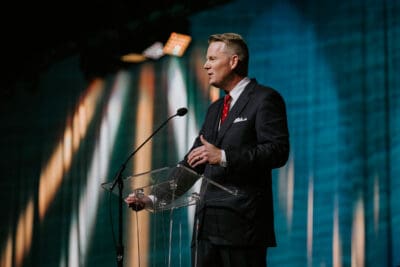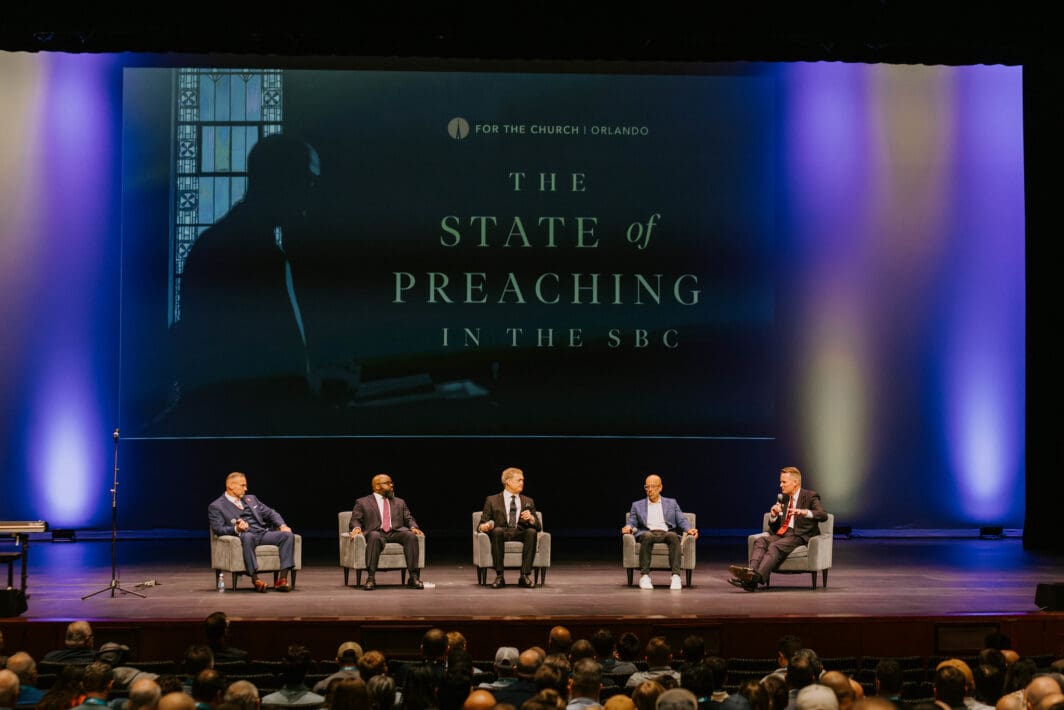
ORLANDO, Fl. – Over 1,400 participants gathered at Midwestern Seminary’s For the Church Orlando event during the Southern Baptist Convention Annual Meeting on June 9 for a discussion led by President Jason K. Allen on the state of preaching in the Southern Baptist Convention.
Joining Allen for the discussion were Southern Baptist Convention President Clint Pressley, Florida Baptist Convention Executive Director Stephen Rummage, Imago Dei Church Pastor Tony Merida, and Shiloh Metropolitan Baptist Church Pastor H.B. Charles, Jr.
The discussion followed a time of worship led by Matt Boswell, professor of worship ministries at Midwestern Seminary, during which attendees sang “All Hail the Power of Jesus’ Name,” “Christus Victor,” and “Here Is Love (Everlasting Praise).”
Opening the conversation, Allen noted Midwestern Seminary’s longstanding commitment to strengthening local churches through faithful preaching.
“Because we exist for the church, no church is healthier than the strength of its pulpit,” Allen said. “No convention of churches will prove to be healthier than the collective strength of the pulpits in those churches.”
Allen reflected on the recovery of biblical exposition that has taken place in Southern Baptist life over the last several decades alongside a renewed commitment to the inspiration, inerrancy, authority, and sufficiency of Scripture. He then invited panelists to assess the current state of preaching across the convention.
A Renaissance of Expository Preaching
Rummage expressed encouragement about what he described as “a real renaissance of expository preaching” among Southern Baptist pastors.
“There was a time where the majority of Southern Baptist preaching would have been topical or textual preaching,” Rummage said. “What we’re seeing now is a real renaissance of expository preaching.”
He noted that pastors today are increasingly committed to identifying the main idea of a biblical passage through careful interpretation and faithfully communicating that message to their congregations.
Merida echoed Rummage’s assessment, observing that younger pastors and church planters often arrive already convinced of the importance of exposition.
“I’m not having to sell exposition. It’s more of, ‘Help us learn how to do it,’” Merida said.
Pressley reflected on his own journey toward expository preaching. Raised in a church committed to biblical authority but unfamiliar with formal exposition, he recalled encountering expository preaching during seminary and discovering a simple but transformative approach to handling Scripture.
“You read the Bible, explain it, and then apply it,” he said.
Charles likewise expressed gratitude for the influence of faithful Bible preachers within Southern Baptist life. While celebrating the growing commitment to exposition, he encouraged preachers not only to handle the text accurately but also to communicate its truth persuasively and clearly.
“You’ve got to get the text right, and you have to get the truth across,” Charles stated.
Christ-Centered Exposition
The conversation then turned to the growing emphasis on Christ-centered exposition within evangelical preaching.
Merida pointed to Jesus’ teaching in Luke 24 as the model for understanding Scripture, noting that the Bible’s storyline consistently points to Christ and His redemptive work.
“We stand in that legacy of preaching the text and pointing people to Jesus,” Merida added.
Rather than forcing connections to Christ, Merida explained that faithful exposition recognizes the themes, promises, and trajectories already present in Scripture and demonstrates how they find fulfillment in Christ.
Building on that theme, Rummage encouraged preachers to ask a simple question of every biblical text: “What is God doing here?” By focusing on God’s redemptive activity rather than merely human examples, he said, preachers can more faithfully connect Scripture to the gospel.
Charles and Pressley similarly emphasized that Christ-centered preaching must move beyond moral lessons or isolated applications to show how every text relates to the saving work of Christ.
“As the preacher, our fundamental duty is to be pointing the souls to whom we preach to Christ,” Charles continued.
Equipping the Next Generation of Preachers
In the final portion of the discussion, Allen asked the panelists to reflect on the needs of the next generation of preachers and the role of mentorship in preparing future pastors.
The panelists expressed gratitude for younger ministers’ love for Scripture and commitment to biblical faithfulness, while also identifying areas where growth is needed.
They encouraged young preachers to pair careful study with passion in the pulpit and an inclination and care for personal holiness in all contexts, noting the need for a vibrant spiritual life. They stated that while study prepares a sermon, prayer prepares the preacher.
Merida urged pastors to preach from hearts captivated by Christ rather than merely presenting information.
“People are hearing not only my words,” he said. “They’re also hearing the subtext of my sermon.”
Charles highlighted what he described as the life, labor, and leadership of the preacher. He stressed the importance of personal holiness, diligent preparation, and faithful pastoral leadership, warning against pursuing celebrity rather than service.
“Christian ministry is about servanthood, sacrifice, and suffering,” Charles said. “It’s not about being a celebrity.”
Concluding the discussion, Allen encouraged both younger and older pastors to invest in the development of future preachers by creating opportunities for ministry experience and faithful mentorship.
“To preach the Word is an honor,” Allen said. “To steward the local church is a privilege.”
Throughout the conversation, the panelists returned to a common conviction: the health of Southern Baptist churches depends upon faithful preaching. As attendees left For the Church Orlando, they were reminded that the future strength of the convention will be shaped week after week in local church pulpits as pastors faithfully proclaim God’s Word and point their people to Christ.
By Jonathan Lumley